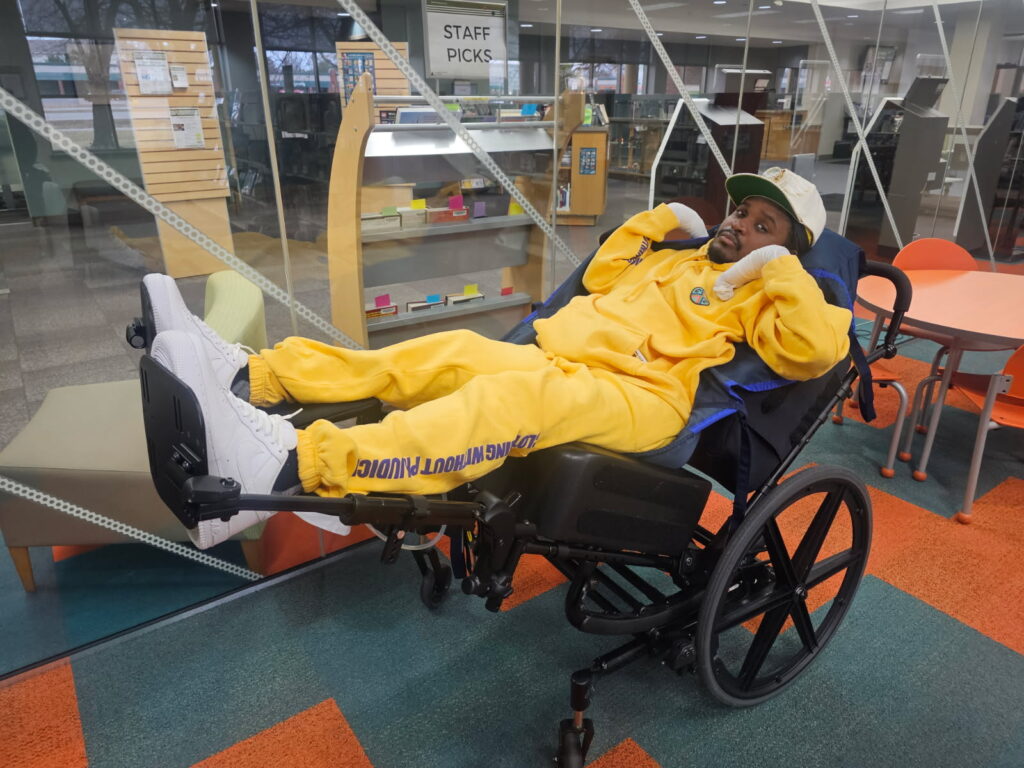
How Darell Reed turned the hardest years of his life into something worth sharing.
Darell Reed is 40 years old, and he has spent the last 13 years building a life that looks nothing like the one most people would have predicted for him. That is exactly how he wants it.
In 2011, Darell was shot by a childhood friend who was living with schizophrenia, and the injury left him quadriplegic from the shoulders down. He was 27 years old, and the road ahead of him was longer and harder than almost anyone could imagine, but Darell has never been the kind of person to stop moving forward.
He started writing, and what began as a private effort to process the world he was navigating grew into something much larger.
“Instead of presenting to the world the negative aspect, I decided to work on something more positive.”
What started in 2017 as a single manuscript eventually grew into a trilogy, with the most recent volume being a self-help publication written specifically for people navigating paralysis, whether physical or mental, and the daily weight that comes with it. Darell wrote it from the inside, with no distance between himself and the reader he had in mind.
“I just finished writing a self-help publication to help people dealing with paralysis,” he said, “whether it’s physical or mental, getting through the hardships of the day.”
He is consistent about one thing, and it matters to him that people understand it: his disability is physical, and his thinking, his ambition, and his drive have never been touched by it.
That distinction, between what the body cannot do and what the mind refuses to accept, runs through everything he has built over the past 13 years.
Building a Care System That Works
Managing care as a quadriplegic is layered and ongoing, and Darell has always approached it with the same clarity he brings to everything else, through good communication, direct questions, and a firm sense of what he needs and why.
When he was first introduced to Asura and the CFSS transition, he was cautious, and he will admit that openly.
“I was nervous when first introduced to Asura and the CFSS transition,” he said, “but Julie listened, helped me navigate the hardships of what I had been trying to accomplish, my goals, my wheelchair situation.”
Julie, his consultant at Asura, walked him through the difference between the budget model and the agency model, explaining how each would affect his caregivers, his schedule, and the type of support he received from one day to the next. For someone who had spent years building a care routine that worked, the idea of changing any part of it was significant, and Julie made sure nothing fell through the cracks along the way.
“Julie was open, listened, and heard me out, added some recommendations on how to approach some things in my life.”
The process turned out to be far more convenient than Darell had expected, with his existing caregivers staying in place and his routine holding steady. What changed was the structure supporting it, and for the first time, Darell had a real and direct say in how that structure was designed around his life.
Paying It Forward
Darell has already sent others in his network toward Asura, people navigating the same transition, weighing the same models, and sitting with the same questions he once had. He doesn’t oversell it, and he is straightforward about the fact that the right fit depends on the person.
“It all depends on the person’s overall situation,” he said, noting that someone’s ability to direct their own care often determines which model makes the most sense for them. For those who are ready and able, he gives Asura a clear and unqualified endorsement.
He has also begun thinking about what comes next beyond managing his own care, including the possibility of helping others with disabilities develop their own plans and find their way through a system that can be difficult to navigate alone. Julie raised the idea with him during one of their conversations, and it stayed with him.
The book, the advocacy, the willingness to sit for an interview and share the details of a chapter of his life that most people keep private, all of it connects back to the same conviction Darell has carried through 13 years of difficulty and growth.
“Never give up, keep striving for greatness. Limitations exist in the mind only. Everything starts with a thought.”
Darell Reed started with that thought, and he has been building on it ever since.